Timelapse calculator
Interval, shots and clip length, worked out before the light goes.
The exposure must end at least 0.5 s before the next shot. Raise the interval or shorten the exposure.
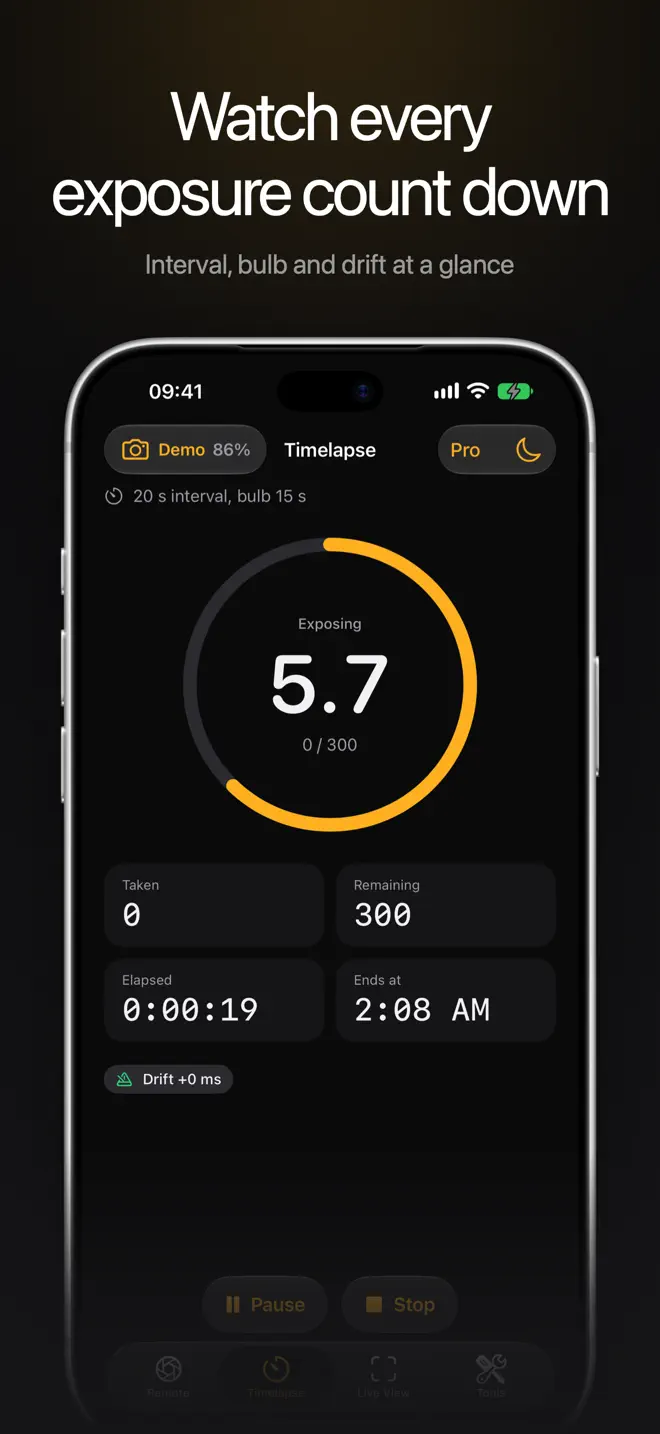
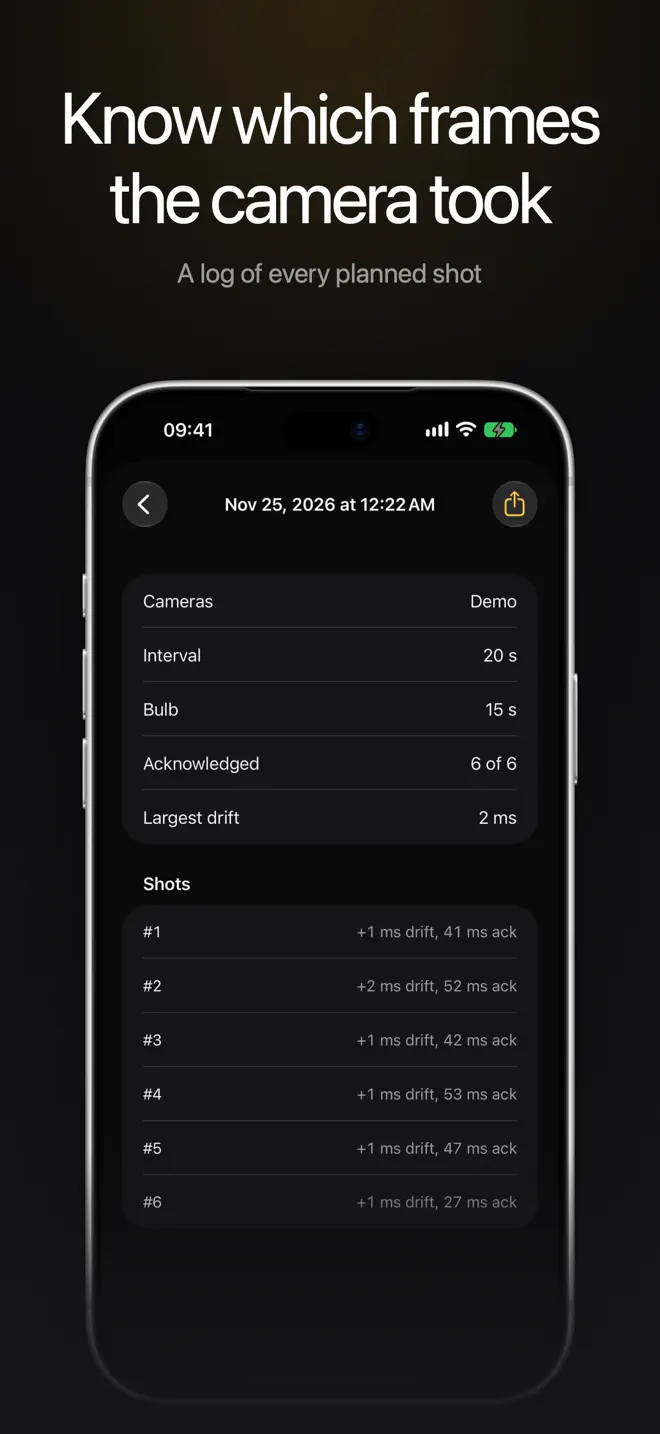
Tetherline runs this plan from your iPhone: it fires a GoPro on the interval and logs every planned shot, whether the camera acknowledged it, and its drift.

Worked out in your browser. Nothing is sent.
Starting points from the app
These are Tetherline’s four presets. Each one is a start: change the interval for the speed of your subject.
| Subject | Interval | Exposure | Shots | Shooting time | Clip at 25 fps |
|---|---|---|---|---|---|
| Clouds | 2 s | Camera | 300 | 9:58 | 12.0 s |
| City night | 4 s | Camera | 360 | 23:56 | 14.4 s |
| Stars | 20 s | 15 s | 300 | 1:39:55 | 12.0 s |
| Star trails | 31 s | 30 s | 240 | 2:03:59 | 9.6 s |
Running it with a GoPro
Tetherline fires a GoPro HERO9 to HERO13 Black over Bluetooth on the interval you set, one photo per shot. Shutter speed and ISO are set on the camera.
The phone keeps the time. Every shot lands in the session log with its drift and the camera’s acknowledgement, so you know on site whether the sequence is whole.
Without Pro, a timelapse with your own camera runs up to 10 shots; the demo camera runs any length.
Questions
How do I choose a timelapse interval?
Fast subjects take short intervals: about 1 to 3 seconds for clouds and traffic, a few seconds for city lights, and 15 to 30 seconds for stars, where each frame is a long exposure.
How long will the finished clip be?
The number of shots divided by the frame rate. 300 shots at 25 fps make a 12 second clip.
Why must the exposure be shorter than the interval?
The camera cannot start the next frame while the shutter is still open. Tetherline asks for at least 0.5 s between the end of one exposure and the next shot, and this calculator uses the same rule.
How much card space does a timelapse need?
Shots times the size of one photo. Check one frame’s file size on your card and enter it; RAW files are several times larger than JPEGs.
Plan the night, let the phone keep time
Tetherline fires your GoPro on the interval, logs every frame and keeps the screen red. Free for iPhone and iPad.