Hyperfocal distance chart
Focus at the hyperfocal distance and everything from half that distance to infinity is acceptably sharp. A 24 mm lens at f/8 on full frame: focus at 2.4 m, sharp from 1.2 m.
Published
Hyperfocal distance in metres
Find your focal length in the row and your aperture in the column. 1 m is 3.28 ft.
| Focal length | f/2.8 | f/4 | f/5.6 | f/8 | f/11 | f/16 |
|---|---|---|---|---|---|---|
| 14 mm | 2.3 m | 1.6 m | 1.2 m | 0.8 m | 0.6 m | 0.4 m |
| 16 mm | 3.1 m | 2.1 m | 1.5 m | 1.1 m | 0.8 m | 0.5 m |
| 20 mm | 4.8 m | 3.4 m | 2.4 m | 1.7 m | 1.2 m | 0.9 m |
| 24 mm | 6.9 m | 4.8 m | 3.5 m | 2.4 m | 1.8 m | 1.2 m |
| 28 mm | 9.4 m | 6.6 m | 4.7 m | 3.3 m | 2.4 m | 1.7 m |
| 35 mm | 15 m | 10 m | 7.3 m | 5.1 m | 3.7 m | 2.6 m |
| 50 mm | 30 m | 21 m | 15 m | 10 m | 7.6 m | 5.3 m |
| Focal length | f/2.8 | f/4 | f/5.6 | f/8 | f/11 | f/16 |
|---|---|---|---|---|---|---|
| 14 mm | 3.6 m | 2.5 m | 1.8 m | 1.3 m | 0.9 m | 0.6 m |
| 16 mm | 4.7 m | 3.3 m | 2.4 m | 1.7 m | 1.2 m | 0.8 m |
| 20 mm | 7.3 m | 5.1 m | 3.7 m | 2.6 m | 1.9 m | 1.3 m |
| 24 mm | 11 m | 7.4 m | 5.3 m | 3.7 m | 2.7 m | 1.9 m |
| 28 mm | 14 m | 10 m | 7.2 m | 5.0 m | 3.7 m | 2.5 m |
| 35 mm | 22 m | 16 m | 11 m | 7.9 m | 5.7 m | 3.9 m |
| 50 mm | 46 m | 32 m | 23 m | 16 m | 12 m | 8.0 m |
| Focal length | f/2.8 | f/4 | f/5.6 | f/8 | f/11 | f/16 |
|---|---|---|---|---|---|---|
| 14 mm | 4.7 m | 3.3 m | 2.3 m | 1.6 m | 1.2 m | 0.8 m |
| 16 mm | 6.1 m | 4.3 m | 3.1 m | 2.1 m | 1.6 m | 1.1 m |
| 20 mm | 9.5 m | 6.7 m | 4.8 m | 3.4 m | 2.4 m | 1.7 m |
| 24 mm | 14 m | 9.6 m | 6.9 m | 4.8 m | 3.5 m | 2.4 m |
| 28 mm | 19 m | 13 m | 9.4 m | 6.6 m | 4.8 m | 3.3 m |
| 35 mm | 29 m | 20 m | 15 m | 10 m | 7.5 m | 5.1 m |
| 50 mm | 60 m | 42 m | 30 m | 21 m | 15 m | 10 m |
H = f² ÷ (N × c) + f, where f is the focal length, N the f-number and c the circle of confusion, all in mm.
How to focus at the hyperfocal distance
Find your focal length and aperture in the chart and focus the lens at that distance. Use the distance scale if the lens has one, or focus on something you know is about that far away.
Err long. Focusing a little past the hyperfocal distance keeps infinity sharp and only pushes the near limit back slightly. Focusing short loses the horizon first.
Autofocus has nothing to lock on in empty space. Focus on an object at the right distance, then switch the lens to manual so it stays put.
Why charts disagree
Hyperfocal distance depends on the circle of confusion, the largest blur spot that still looks like a point. This chart uses 0.03 mm for full frame and divides it by the crop factor for smaller sensors, the same values as the depth of field tool in Tetherline. Charts and lens scales that use 0.025 or 0.02 mm give longer distances.
The 0.03 mm value assumes a print of about 20 × 25 cm seen from arm’s length. If you inspect files at 100 % on a high-resolution sensor, the far horizon may look slightly soft at the charted distance. Stop down one more stop and keep the same focus point.
Night foregrounds
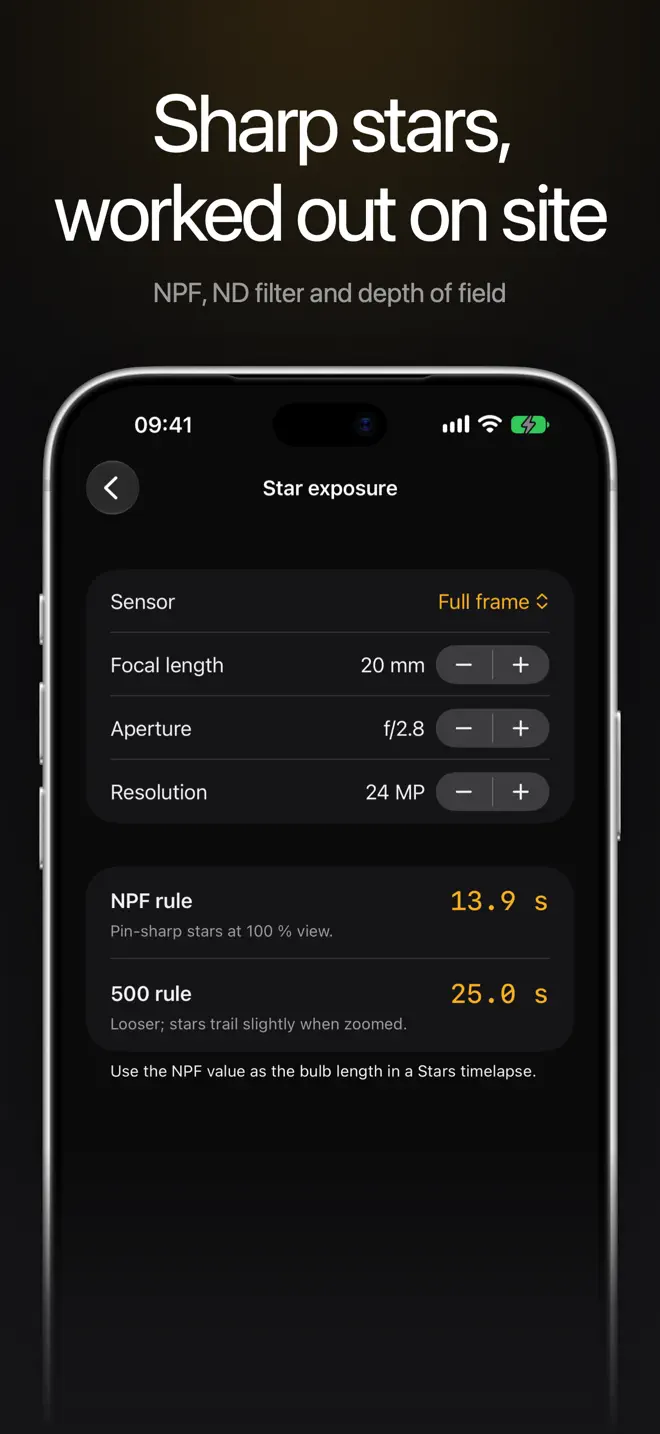
A 20 mm lens at f/2.8 on full frame has a hyperfocal distance of 4.8 m, so anything closer than about 2.4 m will be soft. Stars need the wide aperture to keep the exposure inside the NPF time, so you cannot stop down to fix it.
The usual answer is two frames: one focused on the stars, one on the foreground, blended later. Shoot the foreground frame at the same aperture with a longer exposure or a higher ISO.
The same calculator on your iPhone
Tetherline’s depth of field tool takes the sensor, a focal length of 8 to 600 mm, an aperture of f/1 to f/22 and the subject distance, and shows the hyperfocal distance and the near and far limits of sharpness, offline.
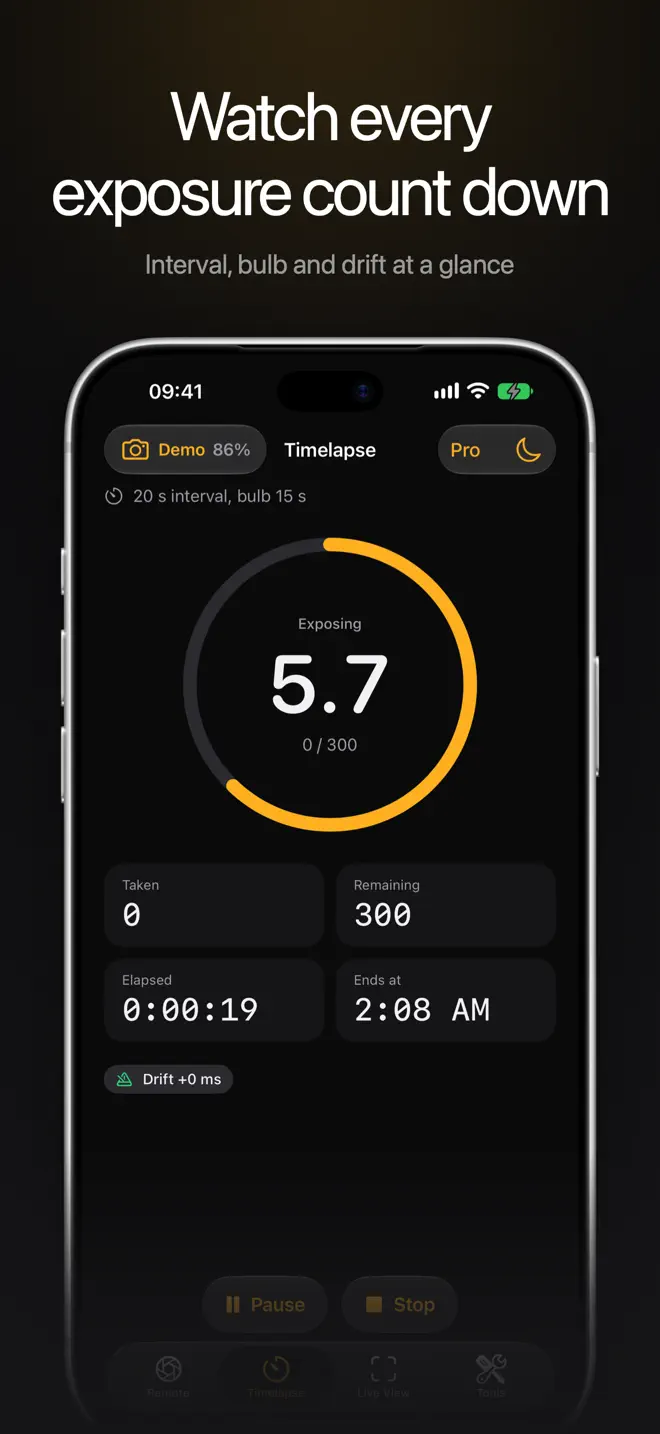
It sits beside the ND filter exposure and NPF star exposure tools, and the remote that fires a GoPro HERO9 to HERO13 Black over Bluetooth.